Why Your Shopify Store Gets Visitors but No Sales — and How to Fix It
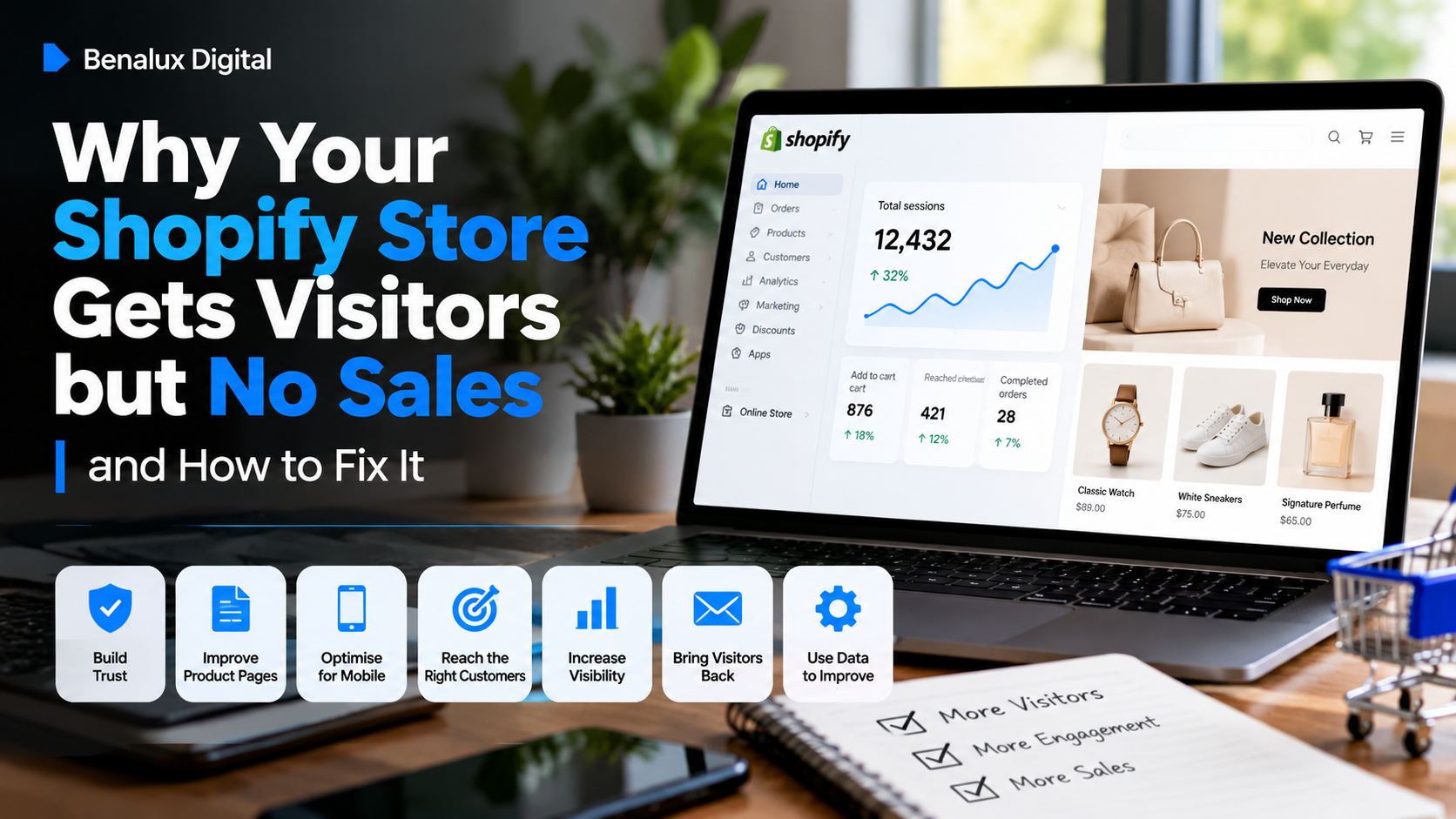
Traffic alone does not grow an e-commerce business. Learn how to identify the barriers stopping shoppers from buying and turn more of your Shopify visitors into paying customers.
Why Your Shopify Store Gets Visitors but No Sales — and How to Fix It
Introduction
You have launched your Shopify store, uploaded your products, designed your homepage, and started trying to attract customers. Visitors may even be arriving, but the orders are not coming in as expected.
It is one of the most frustrating challenges in e-commerce: people visit your store, browse a few products, and leave without buying anything.
The problem is not always a lack of traffic. Sometimes, shoppers cannot find the information they need, do not trust the store enough to make a purchase, or encounter friction during checkout. In other cases, the products are reaching the wrong audience.
The solution is to understand what is happening between a visitor's first click and the moment they decide whether to buy.
Here are seven practical ways to improve your Shopify store's ability to convert visitors into customers.
1. Make Your Store Feel Trustworthy from the First Visit
Customers are more likely to buy when a store gives them clear reasons to feel confident.
When someone discovers an unfamiliar brand, they may wonder whether the product will match the pictures, whether delivery will be reliable, and whether they can get help if something goes wrong.
Your store should answer these concerns without forcing customers to search for the information.
Start with a clear brand identity, professional product photography, easy-to-find contact information, transparent shipping details, and a straightforward returns policy.
Customer reviews can also help shoppers understand other people's experiences. If your store is new and you do not yet have reviews, focus on accurate product descriptions, real product images, and clear policies rather than publishing fabricated testimonials.
The goal is simple: give customers enough genuine information to make an informed purchase with confidence.
2. Improve Your Product Pages
Your product page is where interest needs to become buying intent.
A product title and price alone may not answer the questions that determine whether someone completes an order.
A strong product page should explain what the product does, who it is suitable for, what makes it useful, and what the customer receives.
For example, instead of describing a portable charger only as a power bank, explain its capacity, compatible devices, charging connections, portability, and any important limitations.
Use clear product images, readable descriptions, visible pricing, and an easy-to-find Add to Cart button. Include accurate delivery estimates and relevant product specifications.
Avoid overwhelming shoppers with unnecessary pop-ups or long blocks of text that hide the information they need.
Review your most important product pages first. Improving a few high-potential products may be more useful than making small changes across your entire catalogue without a clear priority.
3. Make Shopping Easy on Mobile
Many shoppers discover products through mobile search, social media, and links shared by other people. If your website is difficult to use on a phone, you may lose customers before they reach checkout.
Open your store on your own phone and go through the entire shopping process.
Can you read the product information without zooming in? Do images load properly? Is the Add to Cart button easy to find? Can you select product variants without difficulty? Are shipping costs and payment options clear?
Pay attention to loading speed as well. Large images, unnecessary apps, and excessive scripts can make a store feel slow.
You do not need an elaborate design to create a good shopping experience. A clear layout, readable text, useful images, and a straightforward checkout can make a meaningful difference.
4. Bring the Right Visitors to Your Store
More traffic is not automatically better traffic.
A visitor who has no interest in your products is unlikely to become a customer, regardless of how attractive your website looks.
Your marketing should reach people who are likely to need what you sell.
Start by identifying the problems your products solve, the people most likely to buy them, and the questions those people ask before making a purchase.
You can then build your customer acquisition strategy around relevant search terms, helpful content, appropriate social media communities, partnerships with creators, and targeted outreach where suitable.
For example, a business selling specialist motorcycle graphics could create useful content around specific motorcycle models and customisation choices. A beauty brand could develop helpful guides around product selection and application.
The closer your marketing matches the customer's actual interests, the more relevant your store becomes.
5. Improve Your Visibility on Google
Google can be a valuable source of shoppers who are actively searching for products or solutions.
However, simply adding keywords to your homepage is not a complete search visibility strategy.
Start with the fundamentals. Make sure important product and collection pages can be discovered and indexed by search engines. Write descriptive page titles and meta descriptions, use clear headings, and create original product descriptions that answer real customer questions.
Your content should reflect the way people search.
A store selling skincare products, for example, might create helpful content about choosing products for different skin concerns, provided the information is accurate and appropriate. A store selling home accessories might publish room-planning or product-selection guides.
Use Google Search Console to monitor indexing, search queries, clicks, and impressions. These insights can help you identify which pages are being discovered and where improvements may be worthwhile.
Search visibility usually develops over time. Avoid relying on promises of instant rankings; focus instead on building useful pages that serve your audience and make your products easier to discover.
6. Give Interested Visitors a Reason to Return
Not every shopper is ready to purchase during their first visit.
Some people are comparing options, waiting for payday, checking delivery times, or deciding whether a product meets their needs.
Where visitors have given permission to be contacted, email marketing can help you maintain the relationship.
Consider a welcome email that introduces your brand, a useful follow-up featuring products relevant to the customer's interests, or a reminder for shoppers who leave items in their carts.
You can also provide helpful product guidance, announce genuine new arrivals, and communicate offers that are relevant to your audience.
Keep your messages useful rather than sending repeated sales pitches. Respect consent, provide a clear unsubscribe option, and comply with applicable marketing and privacy requirements.
The objective is not to pressure every visitor into buying immediately. It is to make it easier for interested shoppers to return when they are ready.
7. Measure What Is Actually Preventing Sales
If sales are disappointing, making random changes can waste time and money.
Instead, examine the customer journey and look for evidence.
Start by tracking the number of visitors, product-page views, Add to Cart events, checkout initiations, and completed purchases. Shopify's analytics and available reports can help you understand where customers are progressing or dropping off.
Consider these examples:
Visitors are not viewing products: Your homepage, navigation, or traffic targeting may need attention.
Product pages receive views but few carts: Review product presentation, pricing, product-market fit, and trust signals.
Customers add products to their carts but do not complete checkout: Investigate shipping costs, delivery expectations, payment options, and checkout friction.
Visitors arrive from marketing campaigns but rarely engage: Check whether the message and audience match the products being promoted.
These patterns are clues, not definitive diagnoses. Use them to decide what to investigate next, then make focused improvements and measure the results.
A Practical 7-Day Shopify Improvement Plan
You do not need to overhaul everything at once. Use the following schedule to begin identifying and addressing your store's biggest barriers.
Day 1: Review your homepage, navigation, contact information, shipping details, and returns policy.
Day 2: Improve the presentation and descriptions of your three most important products.
Day 3: Test the complete shopping experience on a mobile phone.
Day 4: Review Google Search Console and your existing traffic sources, if available.
Day 5: Identify one relevant content topic or customer acquisition opportunity.
Day 6: Review your email capture and follow-up process, ensuring that your communications follow consent requirements.
Day 7: Examine your available store analytics and choose the next improvement based on the evidence.
At the end of the week, record what you changed and what happened afterward. This gives you a more useful foundation for future decisions than making multiple changes without tracking their impact.
Final Thoughts
A Shopify store does not grow simply because its website is online or because visitors are arriving. Sustainable growth depends on reaching the right customers, presenting products clearly, building genuine trust, removing unnecessary shopping friction, and learning from real performance data.
You do not necessarily need to spend more on advertising to make progress. First, understand where the current customer journey is falling short. Then prioritise improvements that address the most important problems.
If you are unsure where to begin, a structured store review can help you identify potential barriers and decide which opportunities deserve attention first.
Want to Identify What's Holding Your Store Back?
At Benalux Digital, we help Shopify brands evaluate their stores, improve the customer experience, strengthen search visibility, and develop practical customer acquisition strategies.
Our performance-based partnership model has no upfront agency service fee. The scope, any marketing budget, required paid tools, and performance-based compensation are discussed and agreed upon before work begins.
Ready to take a closer look at your store?
Visit BenaluxDigital.com to learn more about our approach and discuss potential growth opportunities for your business.
Editorial note: This article provides general e-commerce guidance. Results vary by store, product, market, and implementation; no particular sales outcome or search ranking is guaranteed.
Want this applied to your store?
See how we work — fixed-price services or a performance-based partnership.